

9 min read
Social Media Age Verification UK: Online Safety Act Guide
November 16, 2026
Social media age verification in the UK: what the Online Safety Act requires in 2026
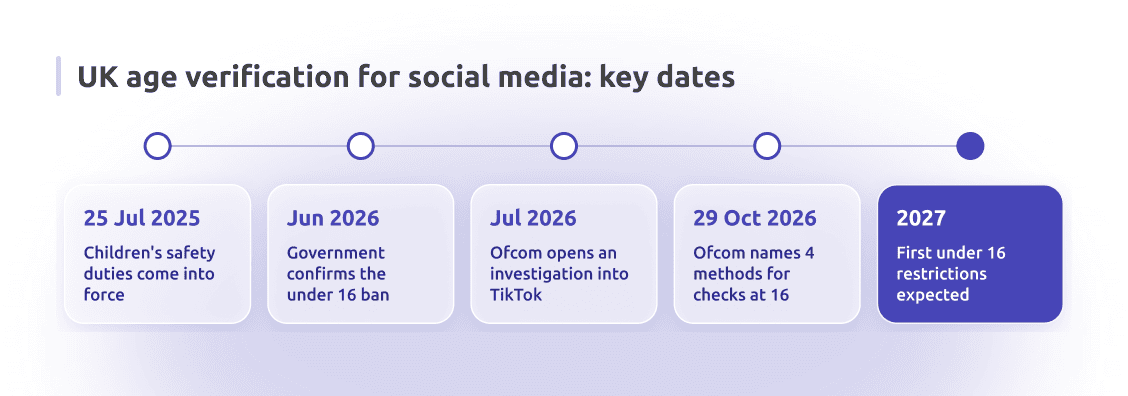
Since 25 July 2025, the UK Online Safety Act has required social media platforms to protect children from harmful content. For the most harmful content, that means running “highly effective age assurance” before a child can see it.
Ofcom enforces the rules. It can fine a platform up to £18 million or 10% of qualifying worldwide revenue, whichever is greater.
The rules are getting stricter. In June 2026, the UK government confirmed a ban on social media for under 16s. On 29 October 2026, Ofcom published its first assessment of which age checks can confirm a user is 16 or over.
Which platforms must comply?
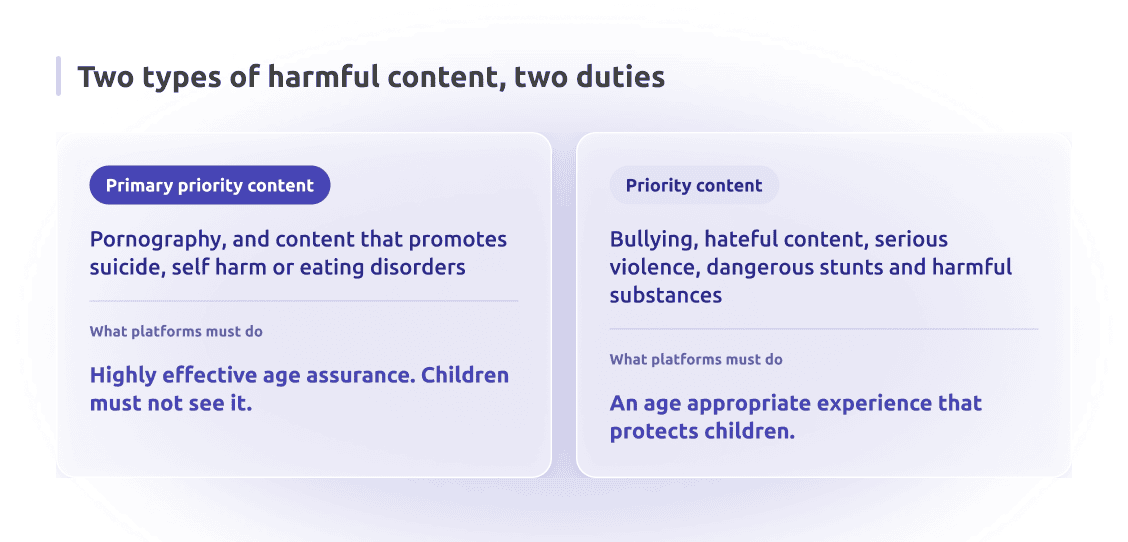
The duties apply to platforms where users can post, share or interact with content created by other users. That covers social media, video sharing sites, forums, messaging features inside apps and many gaming platforms. The Act sorts harmful content into 2 groups, and each group has its own duty:
Primary priority content: pornography, and content that encourages, promotes or gives instructions for suicide, self harm or eating disorders. Platforms must use highly effective age assurance to stop children seeing it, either by age restricting parts of the platform or by blocking under 18s.
Priority content: bullying, abusive or hateful content, serious violence, dangerous stunts and challenges, and content about taking harmful substances. Platforms must give children an age appropriate experience that protects them from it.
Platforms must also stop their recommendation algorithms from pushing harmful content to children.
It doesn’t matter where the company is based. The Act applies to any service with links to the UK: a significant number of UK users, the UK as a target market, or a material risk of harm to UK children.
What counts as highly effective age assurance?
Ofcom judges an age check against 4 criteria: it must be technically accurate, robust, reliable and fair.
For checks at 18, Ofcom lists 7 methods it considers capable of being highly effective:
1. Facial age estimation
2. Digital identity services, including digital identity wallets
3. Photo ID matching
4. Open banking
5. Mobile network operator checks
6. Credit card checks
7. Age estimation from an email address
Self declaration fails the standard. So do terms of service that simply state a minimum age. Age inference falls short
Many social media platforms estimate age from behaviour and activity patterns. Ofcom’s July 2026 report says these methods are not listed in its guidance as highly effective, and it has “serious doubts” that some of these models catch enough children.
Ofcom will accept age inference as a second layer to catch users who get past the first check. It can’t be the first check.
The under 16 social media ban
The UK government confirmed the ban in June 2026. The Children’s Wellbeing and Schools Act 2026 added a new section 214A to the Online Safety Act, which lets the government set the rules through secondary legislation. The first restrictions are expected to take effect in 2027.
The ban targets platforms built for social interaction and user generated content. Messaging services, education, ecommerce and music streaming are not intended to be in scope, though the drafting is still under review.
Ofcom’s rapid assessment of 29 October 2026 concluded that highly effective age assurance can confirm whether a user is 16 or over. Only 4 of the 7 methods made the cut:
Accepted at both 16 and 18: photo ID matching, digital identity services, banking based checks and facial age estimation. For facial age estimation, users close to 16 need a second check. Accepted at 18 only: credit card checks, mobile network operator checks and age estimation from an email address.
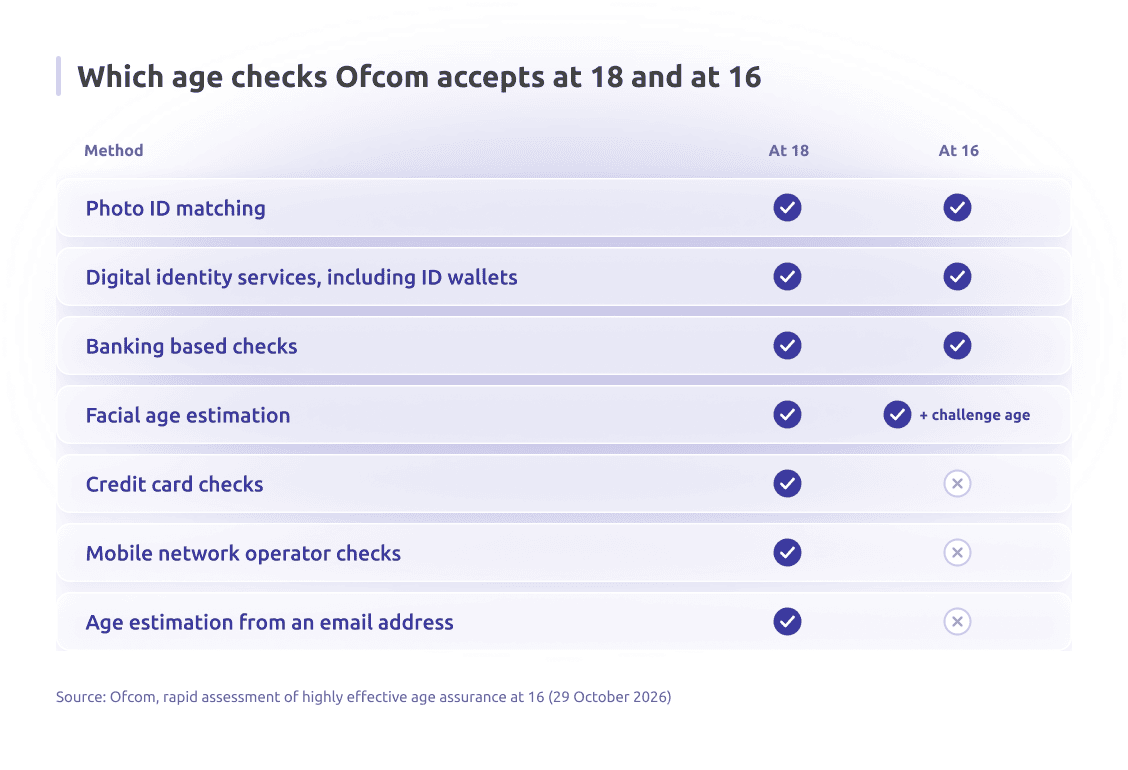
Facial age estimation stays on the list.** Ofcom** calls it the least robust of the 4, because its margin of error matters most close to 16. A user who appears younger than a set “challenge age” needs a second check, with photo ID as the backstop.
Ofcom will consult on formal guidance for checks at 16 once the government lays the regulations.
What are the penalties?
Under the current children’s safety duties, Ofcom can fine a platform up to £18 million or 10% of qualifying worldwide revenue, whichever is greater. It can also go to court for business disruption measures that require payment providers, advertisers and internet service providers to stop working with a platform, or to block it in the UK.
The under 16 regime will also carry fines of up to 10% of qualifying worldwide revenue, and blocking for persistent breaches.
Enforcement is active. Ofcom has opened 23 investigations into providers of 88 adult services and fined 7 of them. In July 2026, it opened its first formal age assurance investigation into a major social media platform, under section 12 of the Act.
How to comply without storing user data
The Act requires an effective age check. It doesn’t require platforms to keep identity documents or selfies, and every stored record is data the platform has to protect under UK GDPR.
At Gataca, we cover 3 of the 4 methods Ofcom accepts at 16:
🇪🇺ID wallet verification. The user shares an age credential from a digital identity wallet. Gataca works with 15+ wallets, including Apple Wallet and Google Wallet, and returning users confirm with a passkey. It works best for returning users and in markets where digital IDs are common.
🤳🏼Facial age estimation. The user takes a selfie, liveness detection confirms a real person is present, and the model estimates age in about 10 seconds. It works best for first visits and for users without a digital ID.
🪪Photo ID matching. The user scans an ID document and takes a selfie. It works best as a second check for users close to the age threshold.
In every case, the platform receives a single answer: this user meets the age threshold (16+, 18+ or 21+), or doesn’t.
Double anonymity
The platform** never learns** who the user is, and Gataca can’t track user activity or build user profiles. No single party holds both the user’s identity and the result of the check, so neither side can rebuild a personal record afterwards. Ofcom and the ICO have both said age assurance and privacy can work together, with a third party confirming only that a threshold is met.
Zero data storage
The age check flow keeps no documents, biometric data or personal identifiers. Everything is deleted after each check.
Certified accuracy
Gataca holds ISO/IEC 27566 certification [TO CONFIRM: tier and effectiveness figure]. Ofcom doesn’t approve individual providers, so an independent certification gives your compliance file evidence a regulator can check.
Reusable checks
Ofcom describes digital ID as “verify once with photo ID, then reuse”. A user who proves their age once can share the same credential with the next platform, without another selfie or document scan.
Requirements can change, so always confirm your obligations with your own legal counsel.
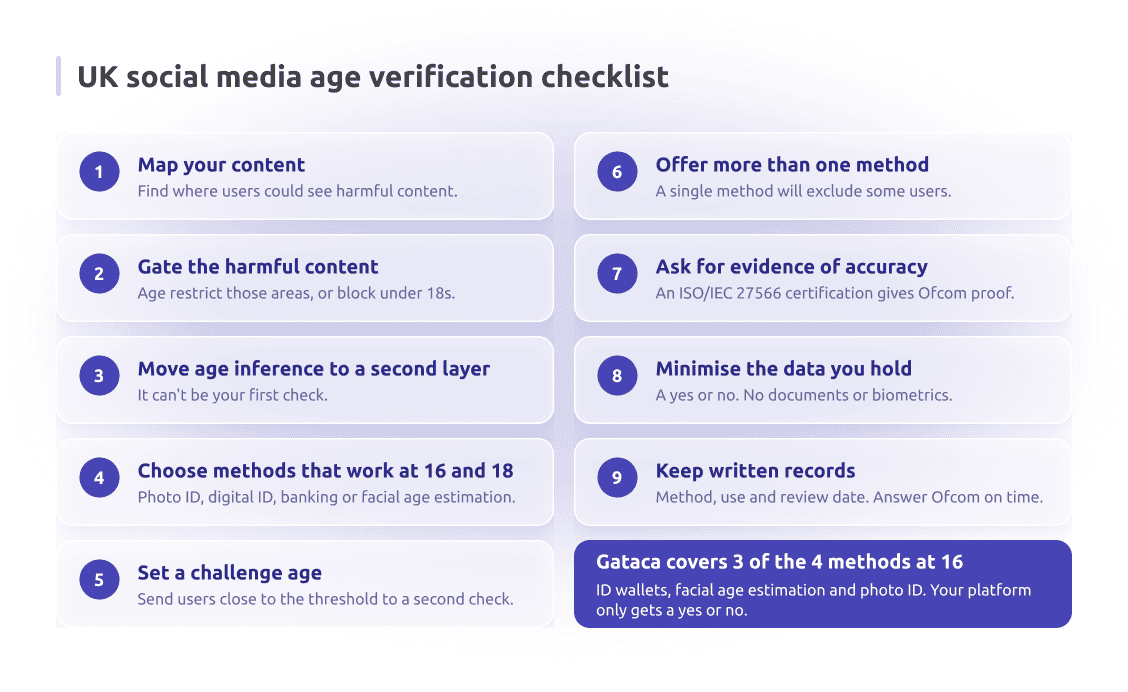
UK social media age verification checklist
-
Map your content. Find out where users could see primary priority content and priority content on your platform.
-
Gate the harmful content. Age restrict those areas, or block under 18s from the platform.
-
Replace age inference as your first check. Keep it as a second layer to catch users who get past the gate.
-
Choose methods that work at 16 as well as 18. Photo ID matching, digital identity services, banking based checks and facial age estimation cover both thresholds.
-
Set a challenge age for facial age estimation. Send users who appear close to the threshold to a second check.
-
Offer more than one method. Around 150,000 16 and 17 year olds in the UK hold neither a passport nor a driving licence, so a single method will exclude some users.
-
Ask for independent evidence of accuracy. A certification such as ISO/IEC 27566 gives you something to show Ofcom.
-
Minimise the data you hold. Prefer a flow that returns a yes or no and keeps no documents or biometrics.
-
Keep written records. Note the method, how you use it and when you reviewed it, and answer Ofcom information requests on time.
FAQ
Do social media platforms need age verification in the UK?
Yes, where children could see primary priority content: pornography, or content that promotes suicide, self harm or eating disorders. Since 25 July 2025, platforms must use highly effective age assurance to stop children seeing it. For other harmful content, platforms must give children an age appropriate experience.
When does the UK under 16 social media ban start?
The government confirmed the ban in June 2026 and expects the first restrictions to take effect in 2027. It will set the rules through secondary legislation under the Online Safety Act. Ofcom will then consult on guidance for age checks at 16.
Which age verification methods does Ofcom accept for checks at 16?
Ofcom’s October 2026 assessment names 4 methods: photo ID matching, digital identity services, banking based checks and facial age estimation. Facial age estimation needs a challenge age and a second check for users close to 16. Credit card checks, mobile network operator checks and email age estimation work at 18 but not at 16.
Is age inference enough to comply?
No. Ofcom’s guidance doesn’t list age inference as highly effective, and Ofcom has doubts about some of the models platforms use. It can help catch children who get past the first check, but it can’t be the first check.
Does the Online Safety Act apply to platforms based outside the UK?
Yes. The Act applies to any service with links to the UK, such as a significant number of UK users or the UK as a target market. Company location doesn’t matter.
Do I need to store user data to prove compliance?
No. The Act requires an effective age check and records of the method you use. It doesn’t require you to keep documents or selfies. With Gataca, your platform receives only a yes or no, and the age check flow stores no personal data.
See a UK compliant age check in action. Gataca verifies age with ID wallets, facial age estimation or photo ID, returns only a yes or no to your platform and stores no personal data. Book a demo

Ana Wedfry
Marketing